
Beneath Your Feet: Why Poundbury's 1,600-Year-Old Secret Matters Now
Highlighted by Graham Chapman
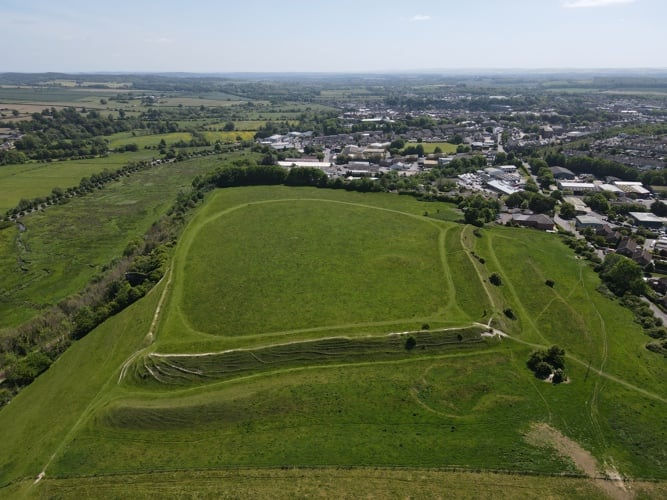
When you moved to Poundbury, you probably thought you were settling in a new development. Modern architecture, contemporary design, a new community. But walk along the roads nearby to the Poundbury Hillfort, and you're treading ground that people chose as sacred 1,600 years ago - long before England was even called England.
One of Europe's Earliest Christian Communities
Around 400 AD, as the Romans withdrew from Britain, someone was buried here with a coffin lid inscribed "INTD", meaning IN NOMINE TUO DOMINE - In Your Name, Lord. It's one of the earliest expressions of Christian faith ever found in Britain, carved into lead when Christianity was still new and revolutionary.
Sparey Green's 1986 excavation revealed something extraordinary: more than a thousand burials, six mausolea with wall paintings, and a cemetery that makes this one of the earliest Christian burial grounds in Europe. Not just in Dorset. Not just in Britain. In Europe.
Yet most Poundbury residents have no idea it's there. The cemetery lies somewhere on the south-eastern slope below the hillfort—invisible in the daily landscape, but profoundly present in the story of this place.
Why This Matters Now
For some visitors, Poundbury can feel like it lacks roots. But the opposite is true. People have been choosing this ground for sixteen centuries - not randomly, but deliberately, as a significant place. We're not living in a development with no history. We're living in a place with such continuous human significance that it's been chosen and re-chosen across the centuries. The Romans knew it. The early Christians knew it. And now, we know it.
What Gets Lost and What Remains
There's something quietly moving about walking your dog or cycling to central Dorchester directly over ground where someone in 400 AD was laid to rest with prayers in Latin, with wall paintings now vanished into soil.
Their names are lost. But their choice of this place - our place - remains. That inscription - In Your Name, Lord - across sixteen centuries, reminds us that people have always sought meaning, community, and permanence in precisely the spot where we're now building our lives.
Poundbury Isn't Just New
Modern Poundbury may be just thirty years old, but the hillfort, the Roman cemetery, the medieval farms - the continuous thread of human presence - stretch back millennia. We're not starting from nothing.
Next time someone dismisses Poundbury as "just a new development with no character," let's smile quietly. We live on one of the most historically significant sites in southern England.
Source: Sparey-Green, C., Farwell, D.E., Molleson, T.L. and Molleson, T.I. (1993) Excavations at Poundbury, Dorchester, Dorset, 1966-1982: The cemeteries. Dorchester: Dorset Natural History and Archaeological Society.
For more information about local archeological attractions, visit the Dorset Museum (reopening February 2026) and Dorset History Centre and our Local Attractions page.