
Scammers have got smarter. Have you?

By Vivienne Westwood
Let me ask you something before we start.
In the last six months, have you received a suspicious call, text, or email — something that felt slightly off, slightly too urgent, or slightly too good to be true?
If the answer is yes, you are not alone. And if the answer is no — read this anyway. Because the scams circulating right now are the most convincing they have ever been. And they are landing in Poundbury letterboxes, inboxes and phone screens just like everywhere else.
IT IS NOT ABOUT BEING CLEVER OR CARELESS
The first thing to understand is that falling for a scam is not a sign of being gullible. Fraud now accounts for over 40 percent of all crime in England and Wales. The people running these operations are professionals. They test their scripts, refine their approaches, and use technology to make their contacts look and sound legitimate.
The targets who get caught are often careful, intelligent people who were simply caught at a busy moment or faced a particularly convincing approach.
WHAT IS HAPPENING RIGHT NOW
Three scams are particularly active in 2026.
The first is the authorised push payment scam. You receive a call or message — often appearing to come from your bank — warning you that your account has been compromised and that you need to move your money to a safe account immediately. The caller knows your name, your postcode, sometimes even recent transactions. They are not from your bank. The safe account is theirs.
Your bank will never ask you to transfer money to protect it. Ever.
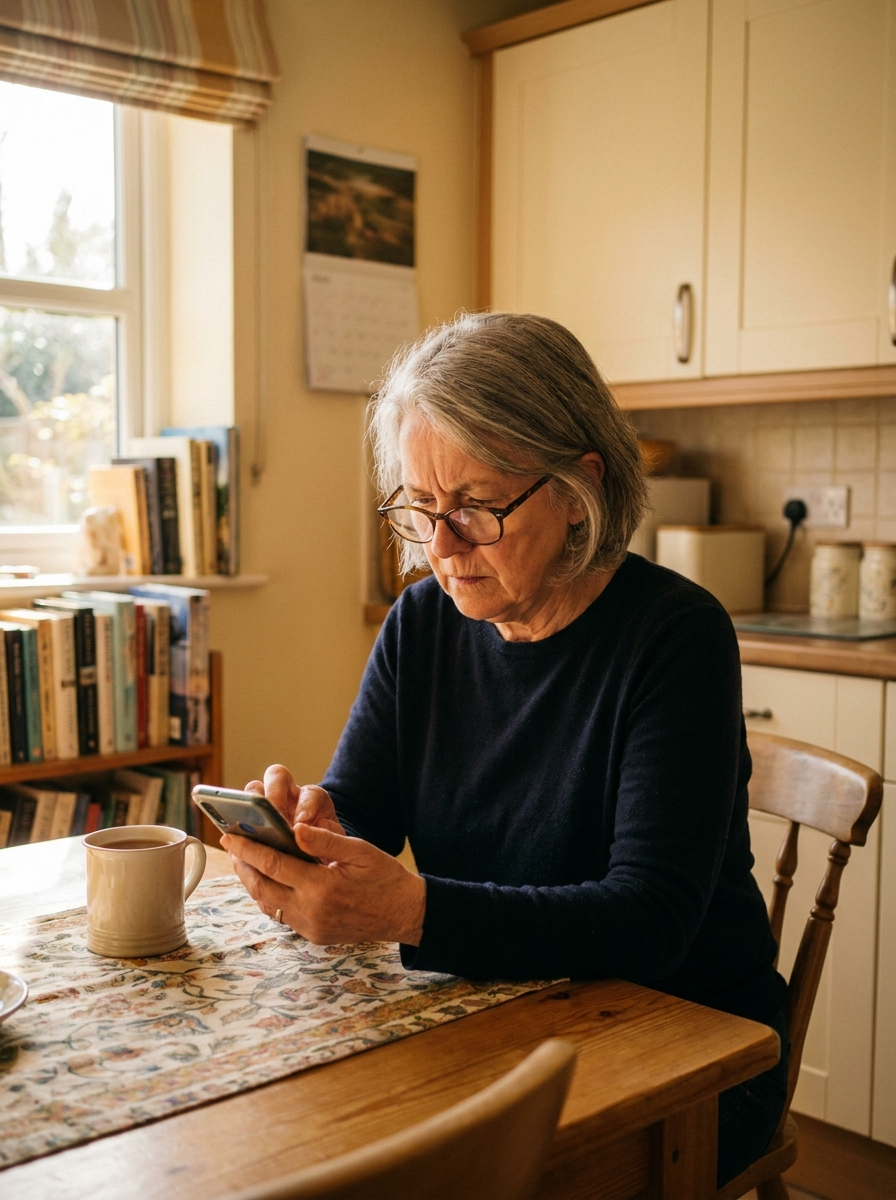
The second is the AI voice clone. Using audio scraped from social media, fraudsters can now generate a convincing imitation of a family member's voice. You receive a call that sounds like your son, your daughter, a grandchild — distressed, in trouble, needing money urgently. This is new. It is real. And it is why having a family code word — a word only your family knows — is now genuinely recommended by fraud prevention experts.
The third is the fake delivery text. A message arrives about a parcel requiring a small customs payment, a redelivery fee, or an address confirmation. The link looks like Royal Mail, DHL, or Amazon. It is not. Never click a link in an unexpected delivery text. Go directly to the courier's website instead.

THE ONE HABIT THAT STOPS ALL THREE
Pause. Verify independently. Never act under pressure.
Genuine organisations — banks, HMRC, the police, delivery companies — will never object to you ending a call, looking up their number independently, and calling them back. If someone objects to that, they are not who they say they are.
WE WANT TO HEAR FROM YOU
Have you or someone you know encountered a scam recently? What happened — and what gave it away? Your experience could help protect someone else in Poundbury.
Email tech@lovepoundbury.org with the subject line Scam Story. We will share anonymised examples in a future issue with your permission.
POLL FOR THIS ARTICLE
Have you received a suspicious call, text or email in the last six months?
Option 1: Yes and I spotted it straight away
Option 2: Yes and I nearly fell for it
Option 3: Yes and I am not sure what to do about it
Option 4: No but I want to know more
To read more Tech Tuesday articles, visit the Tech Tuesday library. HERE